Lucy the Chimpanzee: Her Journey From Home to the Wild
Lucy was raised in a human home from just two days old, but when she was finally taken into the wild, she faced a world she had never known how to survive in. Lucy the Chimpanzee’s life followed a difficult path from a human household toward life with other chimpanzees. Her story begins with separation from her birth mother and follows her efforts to adjust to a life she had never learned.
Chimpanzee rehabilitation is the supported process of helping a captive chimpanzee adjust to life with other chimpanzees and, where possible, to living in the wild. Lucy’s experience shows how hard that change can be, even with human care. Her bond with long-term caretaker Janis Carter shaped the effort, but could not make it simple.
Table of Contents
Her story remains both a record of a difficult transition and a reminder that affection alone could not erase the challenges of that change.
How Lucy the Chimpanzee Was Raised in a Human Home
At two days old, Lucy was taken from her birth mother and brought into the home where Jane and Maurice Temerlin would raise her. That early separation began an unusual childhood shaped by a human family.
The Temerlins raised Lucy as part of an experiment exploring nature and nurture, not as a model for raising a chimpanzee. Their home gave her close contact with people, while her needs remained those of a chimpanzee.
Taken from her birth mother
Lucy was born in 1964 at a roadside zoo in Florida. She left her birth mother when she was two days old, then joined the Temerlins in their home. The change placed her in a human household during the earliest part of her life.
The unusual arrangement reflected the Temerlins’ interest in how upbringing might shape behavior. It did not make a human household a suitable substitute for a chimpanzee family.
Raising a chimpanzee as a human child cannot remove the animal’s needs or make that approach a sound example for others.
Growing up as the Temerlins’ child
Jane and Maurice treated Lucy as a daughter in their family. She shared parts of their daily routine and learned to take part in ordinary household activities.
- Lucy ate with silverware.
- She dressed herself.
- She sat at the dinner table in a chair.
These details show how closely her home life followed a human routine. The family setting was familiar, but it could not prepare Lucy for every challenge ahead.
| Time | Setting | What happened |
|---|---|---|
| 1964 | Florida roadside zoo | Lucy was born. |
| Two days old | Temerlin home | She left her birth mother and joined the Temerlins. |
| Childhood | Temerlin home | Jane and Maurice raised Lucy as part of their family. |
Her childhood setting was a family home, even though Lucy remained a chimpanzee with needs that would become harder to meet as she grew.
What Did Lucy Learn Through Sign Language?
Lucy learned 140 signs from primatologist Roger Fouts, who taught her signs drawn from American Sign Language. The number reflects a learned set, not proof of human-like fluency.
Fouts worked with Lucy as part of primate studies focused on communication between people and apes. Lucy used signs to express some needs and responses. Her ability to learn signs added a new part to her life with humans.
Sign language is a full human language, while Lucy’s learning involved signs taught to her by a person. A count of 140 signs does not show how deeply she understood each sign or how she combined them.
Researchers have disputed how fully apes comprehend signing. Some accounts of ape communication have drawn strong claims from observed behavior, while critics have questioned what those behaviors prove.
That debate matters because learning signs and mastering language are not the same thing. A vocabulary count alone cannot settle questions about thought, grammar, or meaning.
Lucy’s communication skills were part of a wider experiment about how a chimpanzee might respond to human care and instruction. They also gave her ways to interact with the people around her.
Her 140 signs became one part of Lucy’s unusual life with humans, not proof that she experienced language exactly as a person does.
Why Lucy Left the Temerlin Home
By age 12, Lucy’s strength and destructive behavior had made life in the Temerlin home untenable. The move to The Gambia in 1977 aimed to help her adjust to life as a chimpanzee.
That transition was especially hard for a human chimp raised around people. Chimpanzee rehabilitation meant support for adjusting to life among other chimpanzees and, where possible, the wild.
Several connected changes made the home harder to manage as Lucy grew:
- Lucy had reached age 12.
- She had become very strong.
- Her destructive behavior made the household increasingly difficult to manage.
The Temerlins could not give her a life among other chimpanzees in their home. The move sought to offer a chance to build skills and relationships suited to her species.
For Lucy, the change involved more than a new place. She had to leave a human life she knew and face conditions she had not learned to handle.
Sending a chimpanzee raised by humans to a rehabilitation center did not promise an easy return to the wild. It began a long process of adapting to other animals and a different way of life.
The move to The Gambia changed the challenge from managing Lucy in a house to helping her adapt to a life she had never learned.
Janis Carter’s Short Visit Became a Long Commitment
Carter arrived in The Gambia in 1977 expecting to help Lucy adjust for only a couple of weeks. The stay stretched far beyond that plan as Lucy needed ongoing care.
Carter lived with Lucy on a remote, uninhabited island for more than six years. That extended commitment grew from Lucy’s needs, not from an easy or predictable plan.
Carter was 25 when she answered a caretaker advertisement in 1976. She was a graduate student in the University of Oklahoma’s primate studies group.
Lucy and Carter reached The Gambia in 1977. Carter expected to stay for a couple of weeks, but the first visit became a much longer effort.
Helping Lucy adjust meant staying close through changes that did not happen at once. Their island setting was remote and uninhabited, leaving Carter and Lucy to spend their days together.
| Plan or reality | Duration | Setting or purpose |
|---|---|---|
| Planned stay | A couple of weeks | The Gambia, to help Lucy adjust |
| Actual island stay | More than six years | Remote, uninhabited island with Lucy |
| Carter’s role | More than six years | Support for Lucy’s adjustment |
Years alongside Lucy made Carter a steady part of the effort. A short visit had become a long commitment because Lucy could not make the change on a fixed schedule.
That commitment placed Carter beside Lucy through the slow, practical work of learning how to live in a new environment.
What Made Lucy’s Adjustment to the Wild So Difficult?
Lucy had to learn basic survival skills after a life in which she had been raised by people. She struggled to find food and change her diet.
Everyday tasks became new lessons during chimpanzee rehabilitation. Carter showed Lucy what she could eat and how to find it.
Finding food and changing her diet
Lucy struggled to forage, or search for food in her surroundings. She was reluctant to leave her human diet for leaves, so eating required more than simply being in a new place.
Carter demonstrated foods Lucy could eat and showed her how to find them. These lessons addressed practical needs, but they did not make the adjustment quick or easy.
For a chimpanzee used to people and a human diet, the shift brought unfamiliar choices each day. Lucy had to learn which foods were available and how to get them herself.
Communicating and living alongside other chimpanzees
Lucy also faced a change in how she communicated. Carter used ape-like vocal sounds with her rather than sign language, a different way to interact in that setting.
Learning to get food did not resolve the social strain of living near other chimpanzees. Lucy had difficulty relating to them, and practical support could not instantly create trust or belonging.
| Challenge | What Lucy experienced | Carter’s response |
|---|---|---|
| Finding food | Difficulty foraging | Showed foods and how to find them |
| Changing from a human diet | Reluctance to eat leaves | Demonstrated foods Lucy could eat |
| Communication | Human signs did not fit the new setting | Used ape-like vocal sounds |
Lucy needed time to connect food, sounds, and social life in a world unlike her childhood home. The role of a caretaker could offer guidance, but not make each change feel natural.
Carter’s demonstrations gave Lucy practical help, but learning those skills did not immediately solve her difficulty relating to other chimpanzees.
How Lucy Gradually Joined Other Chimpanzees
For years, Lucy struggled to relate to the other chimpanzees around her. Her social adjustment took time, and the eventual change appeared in a brief encounter with Carter.

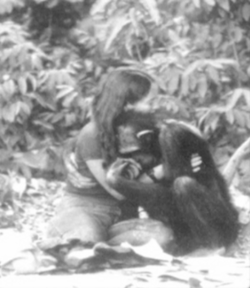
Eventually, Lucy greeted Carter while she was with a group of chimpanzees. Then Lucy left with the group without turning back. Carter saw the departure as a clear moment of separation.
That moment showed Lucy leaving with the group, but it did not prove every part of her adjustment was complete. The observable event was meaningful without answering every question about her life with the chimps.
The change can be seen in three milestones:
- Lucy had difficulty relating to other chimpanzees for years.
- She eventually greeted Carter alongside a group.
- She left with the group without looking back.
Lucy’s departure stood out because she had once relied on a human household and later on Carter’s close presence. The group greeting marked a new kind of contact, even if it could not show what Lucy felt.
Her story did not end with a simple measure of success. Leaving alongside other chimpanzees showed a change in her behavior, while the full course of her adjustment remained uncertain.
When Lucy left with the group without turning back, Carter saw a moment of separation that had taken years to reach.
Lucy’s Disappearance and Death
Lucy disappeared in 1987, and the search ended weeks later with the discovery of her remains. She died that year at age 22-23, but the exact circumstances remain unknown.
The discovery did not explain the cause of her death. Her remains confirmed that she had died, but they did not settle how it happened.
Lucy’s remains do not prove that poaching caused her death, and no confirmed account explains what happened.
The gap between Lucy’s disappearance and the discovery of her remains lasted weeks. That period brought an end to the search, but not a clear account of her final days.
News of her death could not turn an unknown event into a known cause. Claims about what happened must remain separate from the confirmed facts of her disappearance and the discovery of her remains.
Lucy died in 1987, at an age reported as 22-23. The circumstances surrounding her death are not established, so no single cause can be stated as fact.
Her death remains part of Lucy’s story without a confirmed explanation for how it happened.
Conclusion
Lucy’s life connects a human family’s experiment with the long effort to help her live among other chimpanzees. Her experience carries a lasting warning about the limits and consequences of trying to make a wild animal fit a human life.
The 2021 documentary Lucy the Human Chimp offers one account of her life. A one-hour Radiolab episode titled “Lucy” aired in 2010. Neither retelling settles the unknown circumstances of her death.
Readers can seek out the documentary or Radiolab episode and consider what Lucy’s experience says about the responsibilities people have toward animals.
FAQ
Did Lucy’s 140 signs mean she understood American Sign Language exactly as a human would?
No, Lucy’s 140 signs do not show that she understood American Sign Language as a human would. Roger Fouts taught her signs drawn from that language, but a vocabulary count cannot prove human-like fluency. Researchers have disputed how fully apes comprehend signing. Lucy’s learned signs show that she could use a set of signs, not that she mastered the full language.
Did Lucy ever have offspring?
No, Lucy never had offspring. Her life included close ties with humans and a later effort to adjust to other chimpanzees, but she did not reproduce. That fact does not change the central challenge of her story: she had to adapt to life among chimpanzees after being raised in a human home.
Does Lucy’s experience show that every human-raised chimpanzee can be returned to the wild?
No, Lucy’s experience does not show that every human-raised chimpanzee can be returned to the wild. One animal’s outcome cannot establish a general result. Lucy struggled to adapt and needed Janis Carter’s support for more than six years. Her case shows how much time and care one chimpanzee needed, not what will happen for every chimpanzee.
What is the difference between Lucy the Human Chimp and the Radiolab episode about Lucy?
Lucy the Human Chimp is a documentary made in 2021, while Radiolab’s “Lucy” was a one-hour episode from 2010. They are separate retellings of the chimpanzee’s story in different formats. Neither one changes the known facts about Lucy’s life or confirms the circumstances of her death.
Is Lucy the chimpanzee the same Lucy as the famous Australopithecus fossil?
No, Lucy the chimpanzee is not the same Lucy as the famous Australopithecus fossil. The chimpanzee was an individual animal raised by Jane and Maurice Temerlin. Australopithecus afarensis is a different subject, an ancient human ancestor known through fossils. The shared name does not mean the chimpanzee and fossil refer to the same individual.
Why is Lucy’s story sometimes described as a nature-versus-nurture experiment?
Lucy’s story is described that way because Jane and Maurice Temerlin raised her as a human child while exploring nature and nurture. The experiment considered how upbringing might shape behavior. It should not be treated as a sound model for raising chimpanzees, since a human home cannot replace a chimpanzee’s needs or social life.