
Tama the Stationmaster Cat: From Stray to Railway Icon
A stray cat became a railway stationmaster in Japan, turning a small station into a place people wanted to see. Tama the Stationmaster Cat was a female calico cat from Kinokawa, Wakayama Prefecture. Her story joined a rural railway’s uncertain future with a community’s fondness for one familiar face.
Born on April 29, 1999, Tama died on June 22, 2015, at age 16. A maneki-neko is a Japanese beckoning-cat figure believed to invite good fortune and customers. Her journey shows how one cat drew attention to local travel and became part of Wakayama’s identity.
Tama’s story began beside a small station on a line facing an uncertain future.
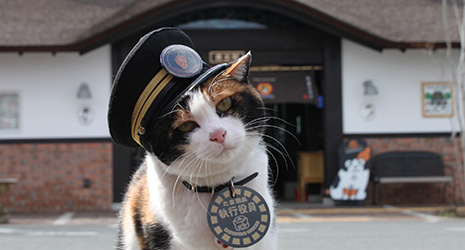
Table of Contents
Why Tama Was Living Near Kishi Station
Near Kishi Station, passengers and Toshiko Koyama fed a group of stray cats, including Tama. Born in Kinokawa on April 29, 1999, the calico cat grew up around the station, where the animals became familiar to people passing through.
Koyama was the informal station manager and cared for the cats. Around 2004, she adopted Tama as the Kishigawa Line faced possible closure because of financial problems. The railway’s future was far from certain, and the cats’ home depended on decisions beyond Koyama’s control.
Permission to stay inside a station did not yet mean a railway job; that distinction came later.
In April 2006, Wakayama Electric Railway removed staff from every Kishigawa Line station to cut costs. Koyama then asked company president Mitsunobu Kojima to let the cats remain inside Kishi Station.
Kojima agreed after seeing Tama and viewing her as a maneki-neko, a beckoning-cat figure linked with good fortune and customers. The idea fit a railway seeking a way to draw attention, though Tama had not yet received a formal role.
The decision to let the cats remain gave Tama a place inside the station before she had an official job.
How Tama the Stationmaster Cat Became a Railway Figure
On January 5, 2007, Wakayama Electric Railway made Tama the official stationmaster of Kishi Station. The appointment turned a cat already living at the rural stop into a public figure, with a simple role that suited her daily routine.
Tama became the first cat formally appointed stationmaster by a commercial railway. Her main duty was greeting passengers, not managing schedules or trains. The railway gave her a title and a public welcome role, while staff continued the actual railway work.
News of the appointment spread through media coverage and drew visitors to the Kishigawa Line. People came to see the unusual stationmaster, take photos, and experience a railway stop where a cat welcomed arrivals.
The role was striking because it began with an everyday act. Tama sat at the station and greeted people, giving visitors a reason to pause before continuing their trip.
The publicity made her a tourist attraction without changing the basic purpose of Kishi Station: serving passengers traveling the local line. The distinction mattered; permission for the cats to stay had come earlier, while the formal appointment gave Tama a recognized job title.
Her public role centered on welcoming people, not performing complex railway work.
The Uniform, Duties, and Promotions Behind Tama’s Job
Tama’s first official duty was simple: greet the passengers arriving at Kishi Station. The railway made that welcome feel special with a custom uniform and clear public duties.
Her stationmaster’s hat took more than six months to make because it needed a special fit. She wore a gold name tag with her name and position, and received a year’s supply of cat food instead of a salary.
A custom hat and a food-based salary
The railway added a summer hat in July 2008. On December 5, 2007, Tama won the Top Station Runner Award, which came with a cat toy and a celebratory slice of crab.
Her family also took part in station life. Chibi, her sister, and Miiko, her mother, served as feline assistant stationmasters, helping make the station’s cat welcome more than a solo act.
About 300 people attended Tama’s promotion ceremony on January 5, 2008. The railway marked her service with a growing set of titles, each tied to a specific date.
Promotions from super stationmaster to honorary president
- December 5, 2007: Top Station Runner Award.
- January 5, 2008: Super stationmaster.
- October 2008: Wakayama de Knight.
- January 2010: Operating officer, the first cat to serve as a railroad corporation executive.
- January 6, 2011: Managing executive officer; January 5, 2013: honorary president for life.
As Tama grew older, the railway reduced her appearances in April 2013. She had greeted visitors Monday through Saturday; her schedule changed to Tuesday through Friday.
Her final promotion made her honorary president for life in January 2013.
The Measurable Effect of Tama on the Kishigawa Line
The clearest early sign that Tama’s appointment mattered was a rise in passenger numbers. Visitors brought new attention to the Kishigawa Line, and ridership figures showed increases soon after her appointment.
The reported figures cover different measures and periods, so they should not be treated as one combined result. One compares January with the same month a year earlier, while another compares March with the previous financial year.
| Measure | Result | Comparison or period |
|---|---|---|
| January passenger numbers | 17% higher | January 2007 vs. January 2006 |
| March ridership | 10% higher | March 2007 vs. previous financial year |
| Estimated local economic contribution | 1.1 billion yen | Publicity surrounding Tama |
The January figure tracked passengers in one month. The March comparison used a different time frame, so the two increases describe separate changes on the railway.
A study estimated that publicity surrounding Tama contributed 1.1 billion yen to the local economy. That estimate reflects the value linked to attention, visitors, and tourism in the area, rather than a direct cash payment to the railway.
The figures help show why Wakayama Electric Railway gave Tama a public role. They do not prove that her presence alone kept the Kishigawa Line running, since a railway’s future depends on many factors.
Tourism also gave the station and nearby area a new point of interest. Visitors had a reason to ride the line, and local businesses could benefit from people making the trip.
Treat the local economic estimate as a contribution linked to the publicity, not proof that one cat alone secured the railway’s future.
The Trains and Station Design That Kept Tama Visible
The railway carried Tama’s image beyond the station office and onto the line itself. In early 2009, Wakayama Electric Railway introduced the Tama Densha, a train covered with cartoon images of Tama.
The decorated train brought her familiar face onto the ride between stations. For visitors, the trip itself became part of the experience, not just a way to reach Kishi Station.
Kishi Station’s cat-shaped building made Tama’s place in the railway visible even when she was not greeting passengers. Rebuilt in August 2010, the station building was designed to resemble a cat’s face, with a thatched roof and stained-glass windows.
The design gave the small station a distinct look without hiding its practical role as an operating stop. The roof and windows added details that visitors could spot as they arrived.
Inside Kishi Station, Tama Café and Tama Shop offer visitor-facing features tied to the cat’s name. They give people places to pause during a visit, while the station continues to serve the Kishigawa Line.
These features kept Tama’s story connected to the railway’s everyday setting. Her image appeared on a train, and the cat-like station building made the destination recognizable from outside.
The station design also helped make a rural stop feel like a place with its own character. It remains part of Wakayama Prefecture’s travel landscape, rather than a display built apart from the working line.
Kishi Station remains an operating stop on the Kishigawa Line, with its cat-inspired design serving as a lasting tribute.
Tama’s Death, Memorial, and Successor Cats
Tama died on June 22, 2015, at age 16, after serving as Kishi Station’s stationmaster. When Tama passed away, she was at an animal hospital in Wakayama Prefecture, where the cause was apparent heart failure.
About 3,000 people attended her Shinto-style funeral at Kishi Station. The railway gave her the posthumous title Honorary Eternal Stationmaster, a lasting honor for her service.
The stationmaster role became a tradition that could continue with other cats, even though no successor could be Tama herself.
Tama’s final honors and shrine
On August 11, 2015, Tama was enshrined as the spirit goddess Tama Daimyōjin at a nearby Shinto cat shrine. Her memorial joined the station’s public life with a local place of worship.
Four practices and honors mark how the railway community remembers her and carries the tradition forward.
- Honorary Eternal Stationmaster, her posthumous title.
- Tama Daimyōjin, her name as a shrine spirit goddess.
- Offerings made by successor cats each June 23.
- Successor cats greeting passengers at Kishi Station.
Nitama and the next stationmasters
Nitama, Tama’s official apprentice, was introduced on January 5, 2012. Railway staff had rescued her from beneath a train car before she joined the station.
In 2022, Nitama and Yontama greeted passengers from the Kishi Station stationmaster’s office. Nitama died in November 2025 at age 15, and Yontama became the station’s third stationmaster on January 7, 2026.
As of 2026, five successor cats, all female calicos, have inherited the Tama name and worked at Kishi Station. Each June 23, the successors are carried to Tama’s shrine for offerings.
The Tama name now belongs to a continuing station tradition, not to one cat alone.
Conclusion
Tama’s legacy links a local railway, its community, and a cat whose presence drew people to Wakayama. Her story shows how a small station can become meaningful through the bond between a railway and the people it serves.
The cats who hold the stationmaster role are living animals, so their work and appearances can change with age and care needs. A visit is best planned with respect for their comfort and the station’s daily routines.
Travelers can ride the Kishigawa Line to Kishi Station and see the cat-inspired setting for themselves. Before visiting Kishi Station, check Wakayama Electric Railway’s current cat appearance schedule.
FAQ
What does “calico cat” mean?
A calico cat has a coat with three colors, often white, orange, and black. Calico describes a color pattern, not a breed. Cats with this pattern can belong to different breeds, or have no distinct breed at all. Tama’s calico coat made her easy to recognize, but it did not define her stationmaster role.
How old was Tama when she became stationmaster?
Tama was 7 when she became stationmaster on January 5, 2007. She was born on April 29, 1999, so the appointment came before her eighth birthday. The railway gave her a public greeting role at Kishi Station, where she welcomed passengers as they arrived.
How long did Tama serve as stationmaster?
Tama served as stationmaster for about eight years, from January 5, 2007, until her death on June 22, 2015. Her main duty was greeting passengers at Kishi Station. The railway later honored her with the title Honorary Eternal Stationmaster, keeping her connection to the station after her death.
Who were Tama’s feline assistants at Kishi Station?
Tama’s feline assistants were Chibi and Miiko. Chibi was her sister, and Miiko was her mother. Both served as assistant stationmasters at Kishi Station, sharing the cat-themed welcome with Tama. Their roles helped make the station’s feline presence a family affair, rather than a job held by Tama alone.
What does Tama Densha mean?
Tama Densha means “Tama train.” Wakayama Electric Railway introduced the train in early 2009, with cartoon images of Tama decorating it. The name links the cat to the railway ride itself, not just to her station office. The train carried her image along the Kishigawa Line.